‘Everyone here is an artist’: J. Muzacz on Los Alamos’s new community-built mosaic
Boomtown sat down with the Austin-based artist to chat about the new mosaic he designed for Los Alamos and the ethos of community care at its core.
Photos by Minesh Bacrania
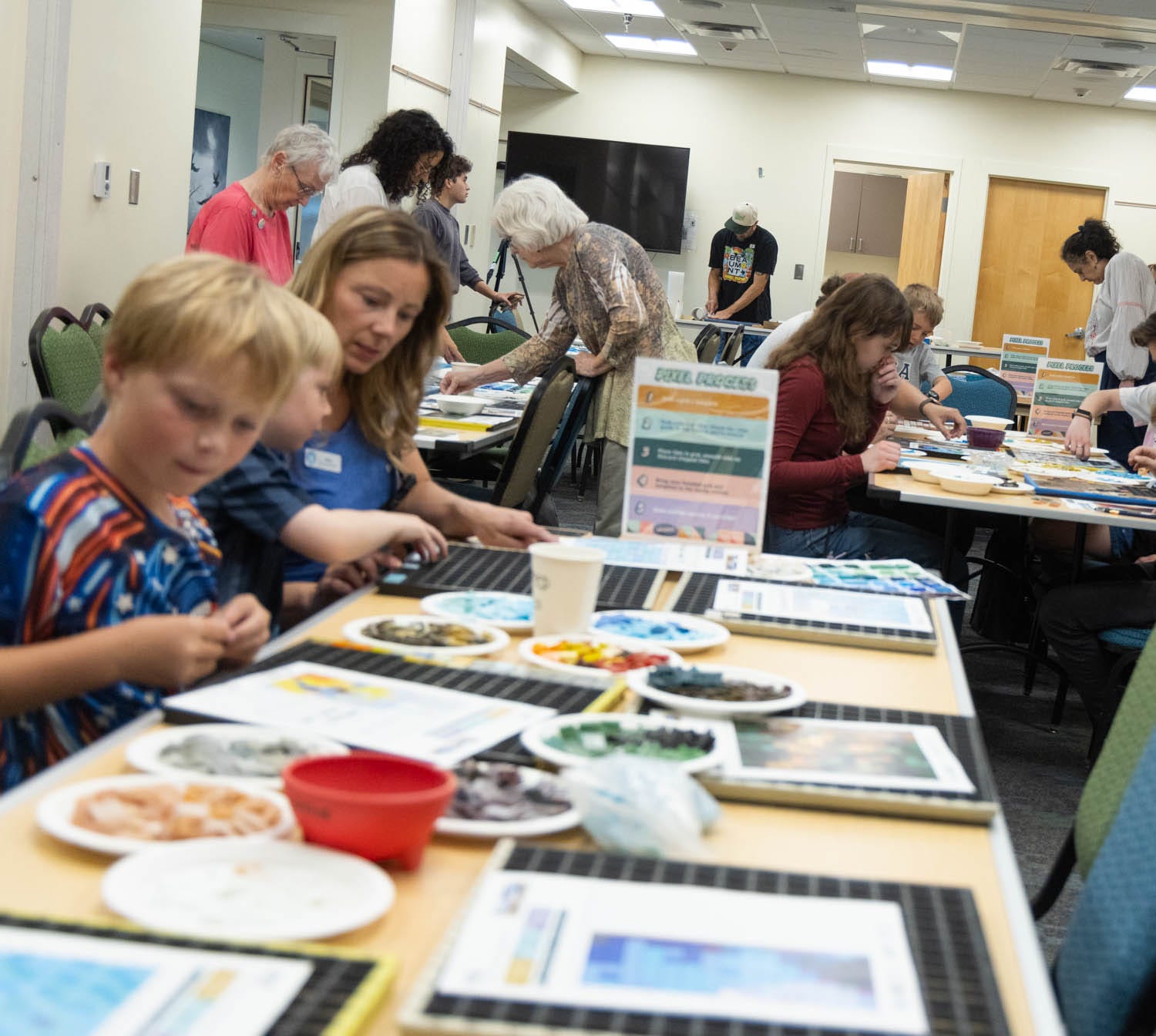
The clinking of thousands of glass tiles fills an upstairs room in the Mesa Public Library, where thirty or so people sit bent over templates they’re laying with colorful patterns. Next to an elderly couple sitting shoulder to shoulder over their shared tray of tiles, an elementary-aged brother and sister help each other pick the right shades from buckets of vibrant oranges, greens, and blues. In an hour or two, their seats will be filled by a quiet teenager and a chatty group of middle-aged women.

They’re assembling pieces of a mosaic designed by Austin-based artist J. Muzacz. Featuring a collage of native wildlife against a sprawling backdrop of mesas and skies, the mosaic will color the south-facing wall at the Los Alamos Justice Center on the corner of Trinity and Oppenheimer.
The colored tiles everyone chooses are open to a degree of interpretation, but Muzacz leans into the uncertainty and puts his trust in the community’s hands and eyes. When he lays out the segments once the workshops are over, he’ll be seeing the finished mosaic for the very first time.
Dreaming in pixels
Muzacz has always been drawn to art that’s open to the public. “Even when I was in high school doing dumb stuff with graffiti,” he laughs, “it was always the freedom of public space. I like the challenge of being outdoors and making something site-specific that ages with the environment, and I like the free viewing of it.” Making something that brings a brief glimpse of beauty to a space hundreds of people pass by every day means more to Muzacz than the formal recognition of a gallery setting with twenty visitors a week and an entrance fee.
Muzacz put together his first mosaic largely by himself, but with help from his wife, Yuki Takata, and a couple of friends. It took weeks to lay out all the tiles. But after becoming a teacher and devising ways to make his art inviting and accessible to all, he’s since refined his process. When the community joins in to help with the assembly, they can knock out a hundred square feet of a mosaic in a day — about 22,000 tiles that would otherwise take him a week on his own.
It’s not just about efficiency. “When people come to contribute to this piece, they can say they had a hand in the built environment,” Muzacz explains. “It builds solidarity among the community, and it builds an ethos of taking care of your space. When people show up and do that, I think it feels good for everybody, even if they’re only doing one square.” In the final piece, Muzacz sees the energy of hundreds of hands preserved in the artwork.
Muzacz starts with a collage in Photoshop, where images are scaled and colors adjusted to fit the available tiles, creating the pixelated, photorealistic style that characterizes much of his art. The entire composition is then split into segments — for this mosaic, a square foot each of 15 by 15 3/4-inch tiles — and templates are created to show which colors go into each segment, and where. Whoever comes to help assemble the mosaic just picks up a template and gets to work.
There are tons of different shades of every colored tile, so it’s inevitable that there will be some mistakes. Muzacz decides to embrace them. “If something’s way off, we’ll fix it,” he says, “but a few little glitches are expected, so most of the time we preserve people’s choices. However the tiles are placed, it’s someone’s unique perspective, and I want to honor that.” He doesn’t think he’s ever done a perfect mosaic — but he also doesn’t think that exists.
Once every template has been completed, Muzacz and his crew — Joey Cruz, Maggie Lyon, and Yuki Takata — arrange and install the mosaic piece by piece over the course of several days. “By the end of it,” he says, “we’ll all be dreaming in pixels.”
Pieces to place
Muzacz designed the mosaic for Los Alamos in collaboration with the county’s Art in Public Places (AAP) board. His focus on collaboration and community engagement meant that residents could be involved in both the design and assembly of the piece. The board posted links to surveys in local press releases, on social media, and on signage around town, where community members had the chance to provide written comments on the scenes and wildlife they felt had an important presence in their lives, and later vote between several designs. Each plant and animal in the mosaic is there because a Los Alamos local wanted it to be.

“The community really put a lot of care into their feedback,” said Chelsea Ashcraft, the APP’s staff liaison. “Everyone who responded was super-specific about what they wanted to see.” After nearly two years of collaboration to find both the site and design that meant the most to residents, their visions are finally taking shape.
This process of dialogue and exchange is what lets Muzacz create art that resonates with communities all over the world. He has projects coming up later this year in New Jersey and Botswana, and he’s previously run workshops in Japan, Mexico, and all throughout Austin in Texas, often making use of recycled tile that would otherwise accumulate in landfills.
Travel gives Muzacz the opportunity to pass on new art forms and new ideas of how a community can repurpose their tile. “No matter where I go, it’s not about showing people the right way to do something,” he says. “I’m sharing what I’ve learned and then seeing where everyone else goes with it. The more I can share with others, the more they can take off and run with their own creative direction.”
This belief in the shared stewardship of his art is clear in the way he laughs off any suggestion of ownership over his latest mosaic. “I don’t need my signature on this thing,” he says, waving the idea away. “The fact that I helped make it happen is enough. It’s your guys’ mosaic now.”
Head to the south‑facing wall at the Justice Center for a ribbon-cutting to celebrate the mosaic’s completion at 11 am on Saturday, June 13.
Muzacz’s other work and projects can be viewed here.


