


Our community is known for its many historic achievements in high-performance computing, but a presentation at last week’s Los Alamos Public Schools Board meeting concluded that the network connectivity issues that have plagued students and staff for many years are primarily due to some basic network management issues.
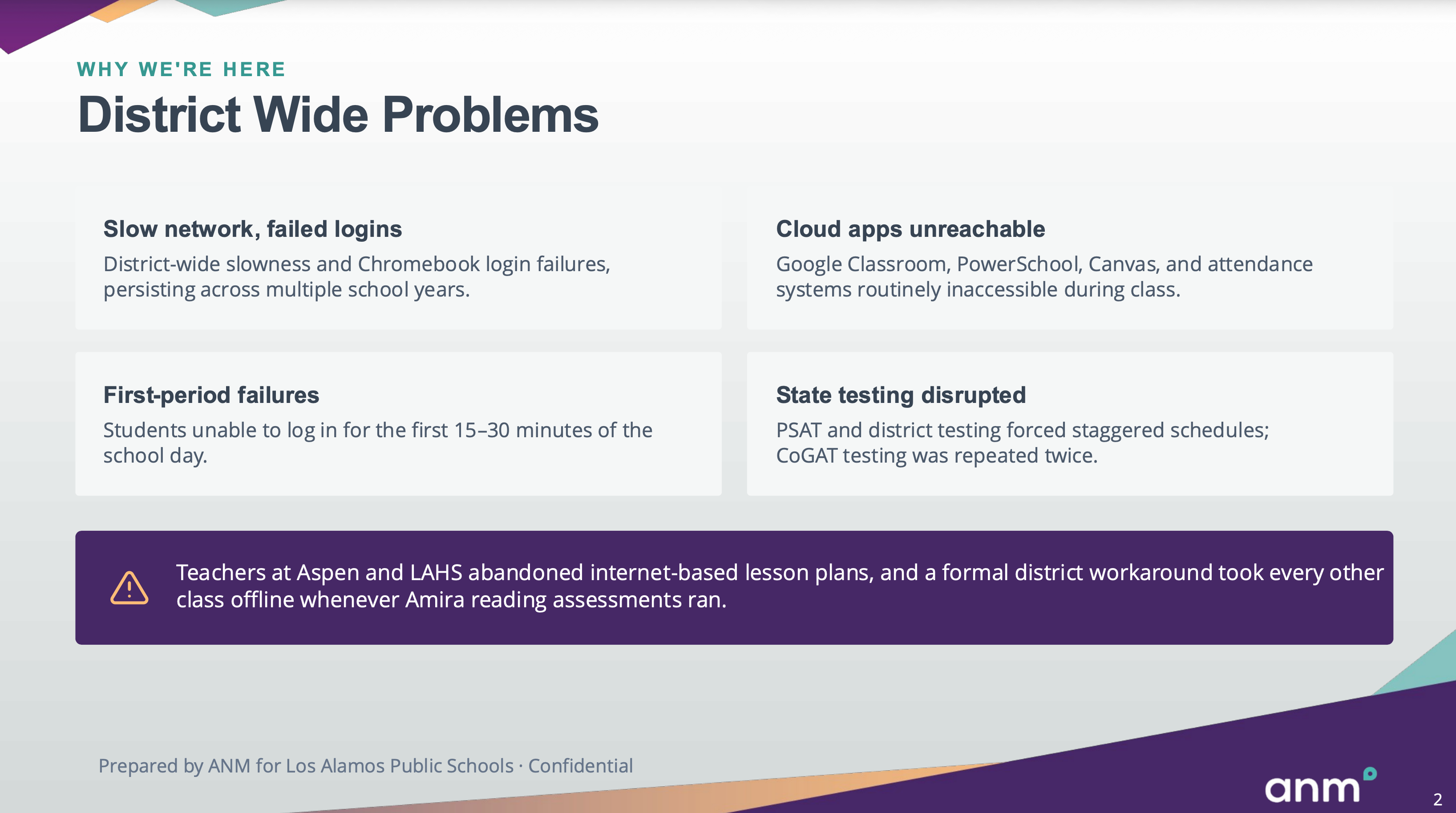
The presentation from Albuquerque-based Advanced Network Management summarized the findings of a district-wide network infrastructure assessment that the company carried out in May and June of 2026.
ANM network engineer and LAHS alumnus David Vigil began by dispelling the long-standing idea that the connectivity issues suffered by LAPS students and staff stemmed from capacity limitations in the connection between the district’s network and the outside world.
“We discovered that [bandwidth] is not currently a constraint,” Vigil said. “What we did discover, though, is that there are five compounding issues throughout the entire district. The network is completely unstable.”
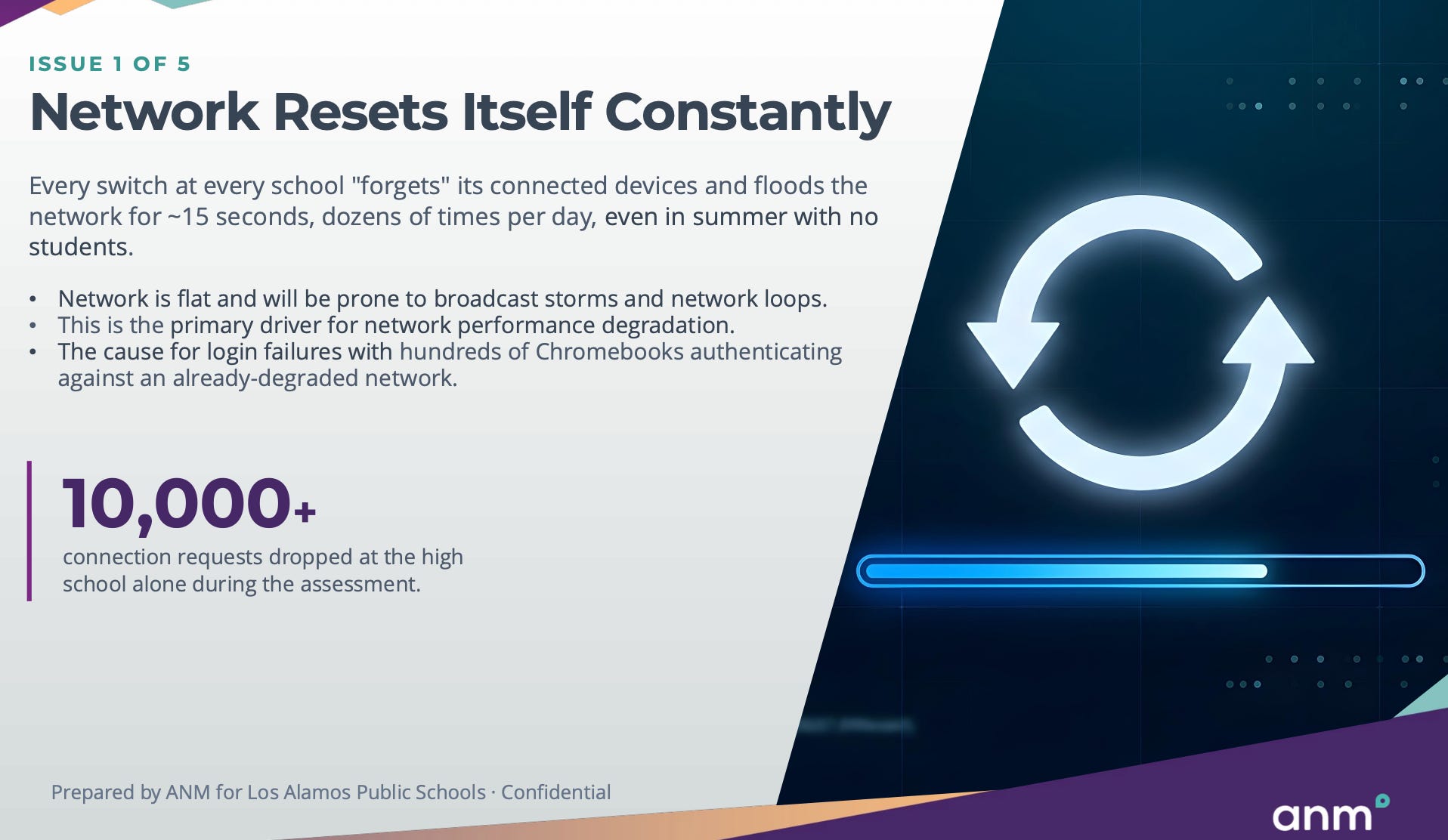
Vigil said that at every school across the district, the network is “constantly resetting itself throughout the day, several times a day, without any intervention” and that multiple devices on the network are “screaming” without any type of filtering or configuration to prevent what is called broadcast storms.
The problem is exacerbated by the fact that more devices that are powered through their ethernet connections, such as cameras and PA systems, have been added to the network over the years, and that when an associated network switch can’t meet the required power demand, it simply shuts off and resets its connection between all of the attached devices.

A third issue is that the wireless access point infrastructure is obsolete, Vigil said. “It might have been correctly built several years ago, but today, with the technology that you guys have within your environment, it’s currently undersized.”
ANM’s engineers also heard from teachers and staff during the assessment that Wi-Fi signal availability also fluctuates greatly across the district’s campuses.
The final contributing factor called out by the assessment is the lack of traffic prioritization on the network. Information for critical applications, such as Google Classroom or testing applications, is currently given the same priority as traffic from students casually surfing the web. While total bandwidth is not a limitation of the current system, Vigil said the system should be optimized to meet best practices to make sure critical traffic is prioritized over everything else.
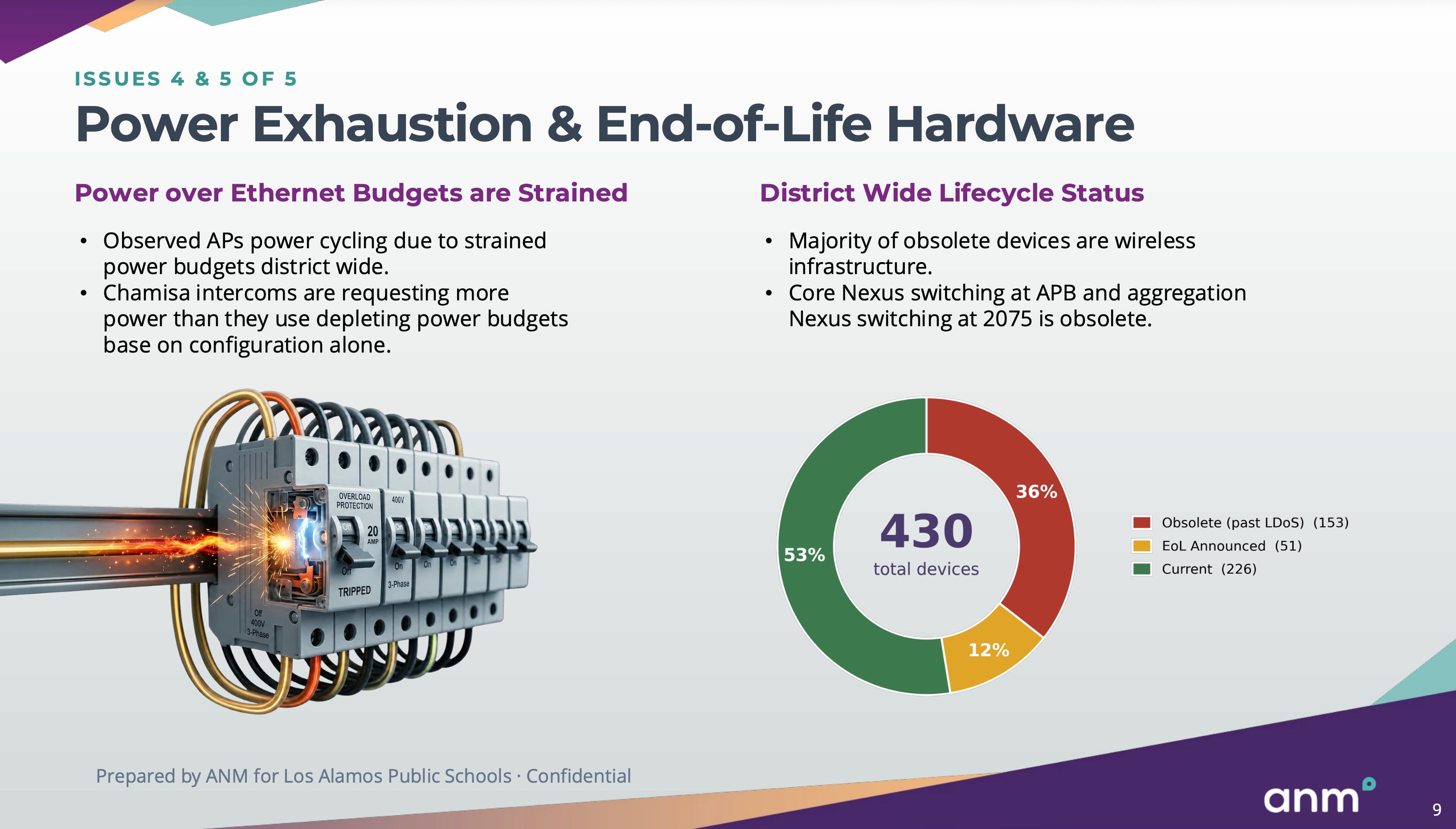
Most of these issues can be solved through simple configuration changes, but Vigil and his colleagues also found that a “significant amount of obsolete hardware” remained throughout the district, “from wireless access points to network switches to even critical infrastructure points.” These obsolete components — also known as “end-of-life” equipment — are hardware items that are no longer supported by the manufacturer and, while still functioning, can lead to security vulnerabilities in the network.
The district’s network is also lacking in redundancy. Vigil said there are at least two “very critical pieces of equipment” that handle core networking tasks for the district and added that if those devices were to fail today, “there could be significant outages throughout the entire district.”
The bottom line of ANM’s assessment of the district’s network infrastructure was stark. “The network is not finely tuned or optimized to handle standard traffic,” said Vigil. “In our opinion, it doesn’t meet standard network best practices — from our standpoint, as well as Cisco’s best practices.”
LAPS Director of Technology Salvador Zapien and his colleagues have gratefully embraced the new information provided by the ANM assessment.
“We were kind of lost in the weeds trying to figure out what’s going on,” he said. “It’s good to have a partner like ANM to come in and show us how a modern network should be like.”
He added: “The network has kind of just been, if you can imagine, it’s from the early 2000s. Once something new came in, we just copied whatever configuration from the old things and put it on the new things and just kept going.”
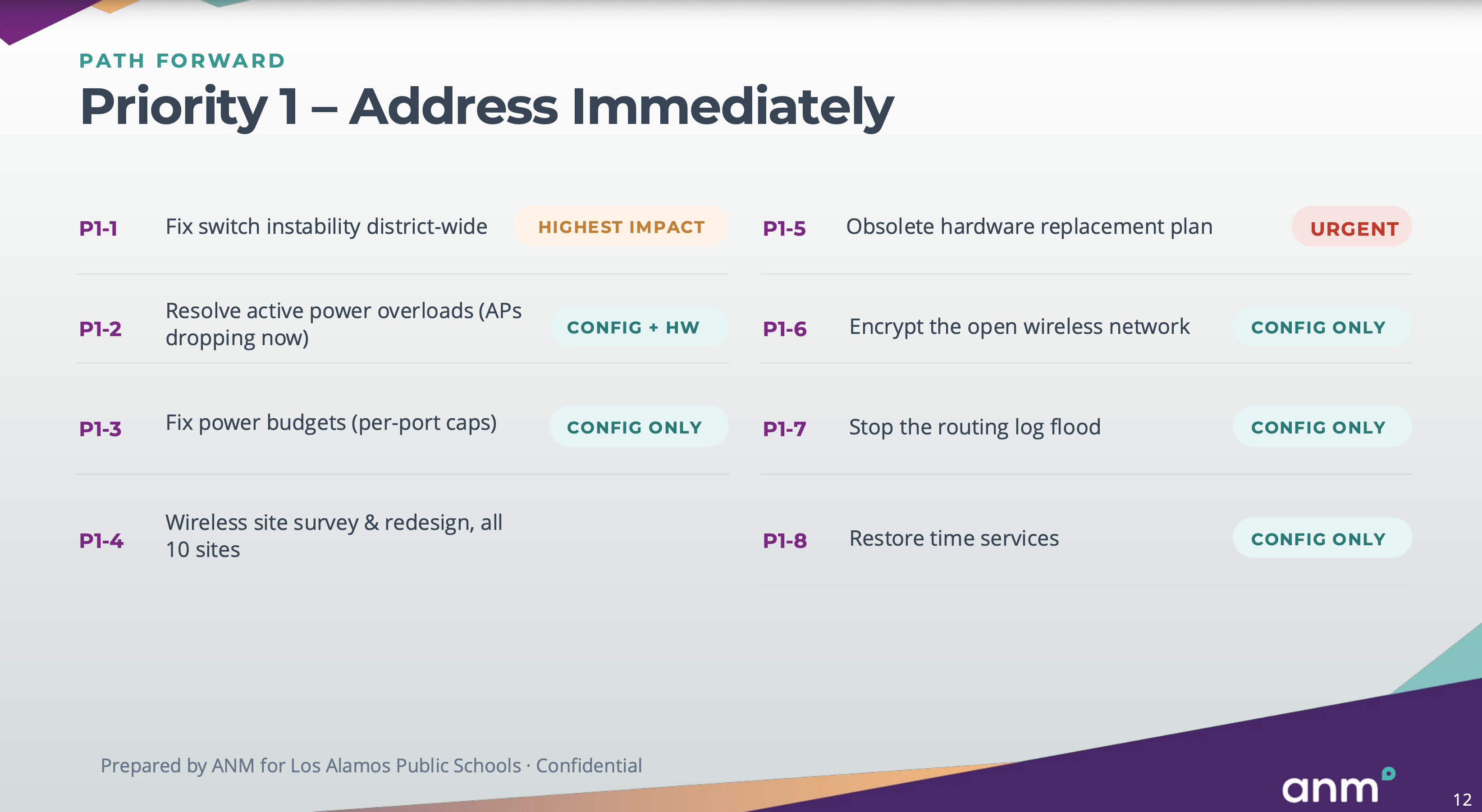
ANM emphasized that the most immediate improvements can be realized through relatively simple configuration changes. Zapien and his colleagues have already begun implementing some of the changes recommended by ANM, and Superintendent Jennifer Guy said that students and staff will notice an improvement over the next month.
Guy also admitted to the board that this is a bigger problem than the school’s in-house IT department can efficiently handle. “We keep a very small staff intentionally, because we have historically contracted work such as this, with companies such as ANM, so that we aren’t paying full-time salary for five people when we don’t need them every day, day in and day out. We’ve always understood that the trade-off is, at times, we do have to make a larger investment to be able to continue to operate functionally, and then we can drop back to our staff and operate efficiently.”
The school board unanimously approved Guy’s request to enter into a contract with ANM to implement the changes recommended in their infrastructure assessment, as well as to work with the district to develop a long-term plan that addresses the overall resilience and functionality of the district’s technology infrastructure.
The funds for this contract, which will not exceed $475,000, will come from the district’s $12 million “leased property” account. The specific scope of work for the contract was given to the board but not included in the published meeting materials. Boomtown’s e-mail requests to Superintendent Guy, Assistant Superintendent Carter Payne, and Board Secretary Nancy Brugh requesting a copy of the contract remained unanswered as of Boomtown’s publication deadline.
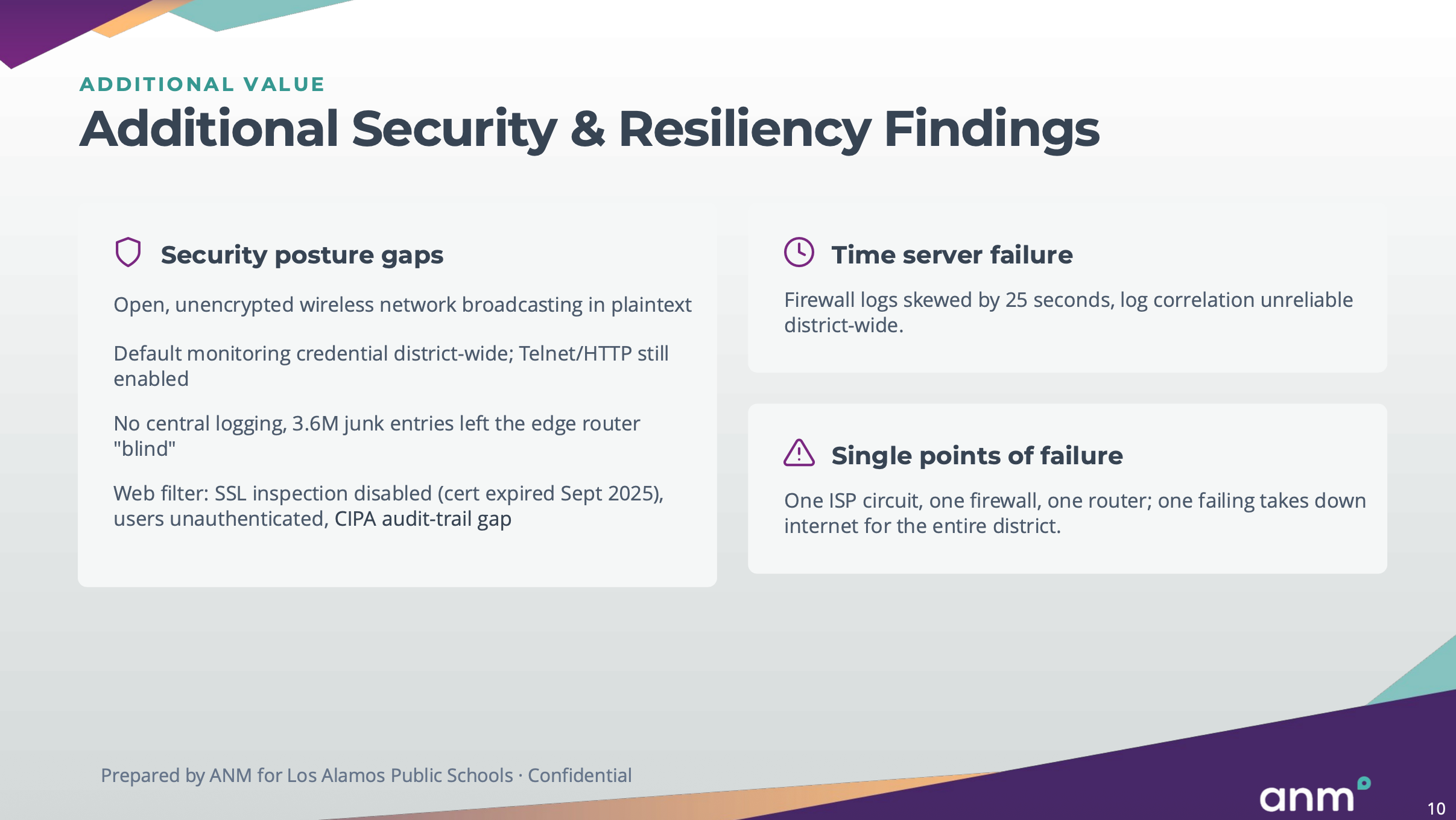
LAPS board member Antonio Jaurigue asked ANM officials whether the infrastructure improvements would also address some of the incidental cybersecurity findings that were highlighted in the presentation. ANM Account Manager Bart Goodman said that the stated goal for this infrastructure assessment contract was to “focus primarily on getting the network fixed” and not to provide a security assessment. Superintendent Guy acknowledged that the district “may want to look at having [ANM] do a separate security assessment. It’s been a while since we did that, so it may be time.”
No mention was made at the meeting about revising the district’s published technology policies, most of which have not been revised for nearly a decade.
The district’s video of the August 11 meeting can be found here.